
JABELINBOARD KJ METHOD FOR VERIFYING CONDITIONS: Non-STA Web App Development Flow

Hi. I'm the engineer Kawashima.
The roses on the road have been blossoming, and walking is a fun season. Recently it has been a bit hot, but ... (Laughter)
This is the third special feature to introduce Nonsta’s web app development flow.
previous article In this article, we introduced the persona empathy map customer journey, a method to delve deeper into the expected users.
If you’re wondering, “How long will it take to verify your hypothesis and when will we get into development?” (laughs).
But if you skip the verification step and develop it all of a sudden, there’s little chance that someone can really solve their problem.
At this point, we haven’t confirmed the prerequisites for the issue yet; if we rush to develop it here and later fall into a premise and go back to the drawing-out, then time and cost will be wasted.
That’s why we spend a lot of time validating before development.
Now that the expected user is solidified, we are ready to verify the prerequisites for the challenge: The Javerin Board KJ method is a useful method for verification.
Contents [ hidden display ]
javelin board
The Javelin Board is a tool designed by Javelin to verify the hypothesis of problems.
It is also called the Javelin experiment board, and as the name of the experiment (experiment), it is a method to devise experimental methods such as interviews and surveys and visualize the verification process.
After putting the hypothesis of “who solves a problem, and by what means?” and “what are the prerequisites that make it work?” into one table, experimentation will validate the prerequisites and modify them further through the results – this is a rough flow of the Javelin Board.
This slide is easy to understand, so if you want to learn more please refer:)
The Four Basic Questions of the Javelin Board
The javelin board begins with the following four questions:
- Who is the customer?
- What are the customer challenges?
- What kind of solutions work?
- What are the prerequisites for the above?
1-3 questions have already been verified using the Lean Campus Persona, Empathy Map and Customer Journey.
But the prerequisite for 4 is still mostly blank, so I'll dig into it in detail here.
classify preconditions
First of all, I will list the prerequisites that make up the problem hypothesis which has been thought so far.
For example, in our case, the persona we created last time
- what you feel is the challenge.
I’m not good at IT and the internet, so it can be a hurdle when creating websites.
You can’t use the existing website creation tools, and they look cheap.
Portal site-dependent attracters are less likely to make repeats and have a fee to pay.
Managing reservations and customer information is complicated with analogue.
We assumed the above issues.
There are prerequisites for this issue, such as “Reservation and customer information management is generally done in analog form, so it is a burden” or “I feel inconvenient with existing website creation tools.
These are only assumptions of the creator, and if we actually verify them, it may be that “the digitalization of reservation / customer information management is already progressing” or “the advantages of analog management over digital”.
If that happens, we will not be able to solve the problem as expected and naturally need to reconsider our solution.
Once you list the possible assumptions, we will map them on two axes below to make sure that verification is especially necessary.
- a large/small impact on an issue when the assumption is broken)
- Large/small premise uncertainty (Does it need to be clarified or verified without verification)
In the end, a large and uncertain premise that has an impact on the task) This is the premise to be verified.
consider ways to verify uncertain premises
Subsequently, we will clarify what means and criteria are used to investigate the actual conditions of uncertain premises.
The possible means of investigation vary depending on the premises, but the standard uses one that can be measured quantitatively (such as if you interview more than ○ people and get support from ○ % or more).
Once the verification methods and standards are established, write them to a javelin board with uncertain assumptions.
Below is a simple sample of the javelin board that has been written so far.
* If there are multiple uncertain premises, we will increase the number of experiments and the entry column horizontally.
| Experiments (First) | ||
|---|---|---|
| customer | therapist (owner of a private salon) | |
| task | management of reservation and customer information is complicated | |
| solution | To provide a simple customer information management system in cooperation with a reservation system. | |
| uncertain prerequisite for an issue | i'm managing customer information on paper and i think it's inconvenient. | |
| Verification Methods and Criteria | over five interviews, more than 50 percent feel inconvenient. | |
| GET OUT OF THE BUILLDING! | ||
| experimental result | (Laughter) | |
| learning from an experiment | (Laughter) | |
The Javelin Board template contains the phrase "GET OUT OF THE BUILLDING!" between the verification method and experimental results :)
It is natural to not think only on a desk, but actually meet with users and see the site, but it is very important.
Outside of the office — experimenting to validate assumptions
I will leave the office immediately and carry out an experiment based on the verification method established earlier.
We have a lot of interviews in the verification process because it is essential for people who actually use an app to create web apps.
However, if you interview a cloud of darkness, it may not be possible to judge as an interviewer which information is important and both parties will spend time wasted.
In order to find valuable information hidden in casual words and have a more constructive dialogue with interviewers, the hypothesis verification method introduced here from the first edition of this feature will be useful.
KJ method
After completing a series of interviews, it is necessary to organize and analyze the results.
At that time, we use a technique called the KJ method as an analysis method for interview results.
The KJ method was invented in 1967 by the cultural anthropologist Jiro Kawakita to organize and integrate information.
This method was originally devised to conjure up vast amounts of information about fieldwork, but it is also useful for finding commonalities and new shipments from a lot of information, so it has been used in brainstorming etc.
organize and integrate interview results
The rough flow of KJ law is as follows.
- divide the information obtained in an interview etc.)
- cardify each of the divided information (*do not combine multiple pieces of information into a single card)
- group cards with similar meanings and context
- label ~ as a group
- sort cards by group so that the association of groups can be logically explained
- translate ~ into language
The KJ method has a long history since it was invented, and various commentaries have been published.
If you want to learn more, we recommend the following article in an easy-to-understand way.
Brainstorming and KJ Method
KJ Law Doesn't Fail Now!
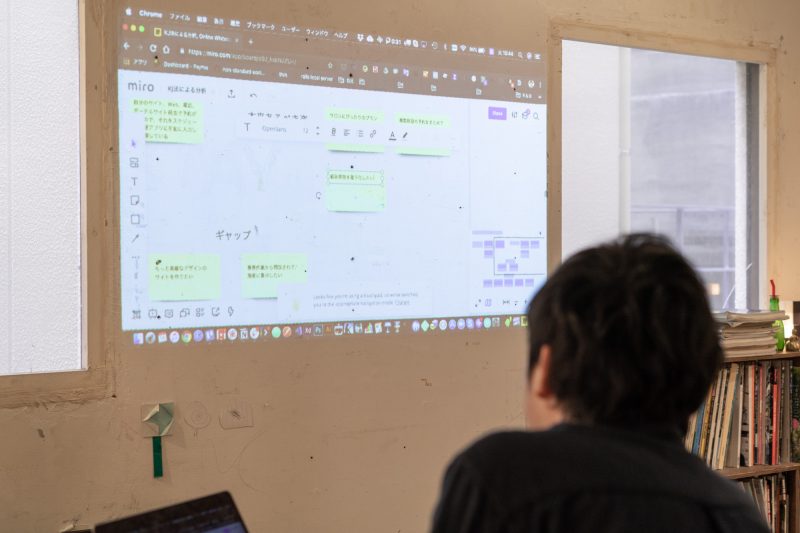
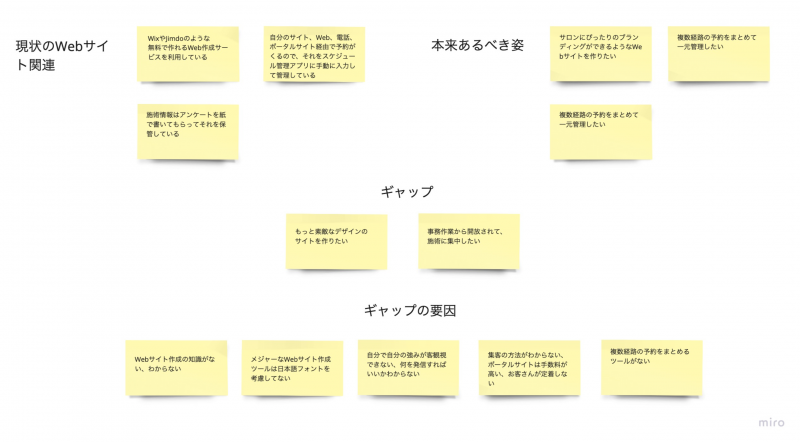
Well, we also tried to organize the actual interview results by KJ law.
There are now services that allow you to card and organize on the web, which can be useful when whiteboards or imitation paper aren’t available (we do). miro i'm using it.
modify a hypothesis based on the learnings from an experiment)
Once you’ve analyzed the results of your interview, go back to the javelin board.
Then, write down the experimental results and the learnings from KJ method analysis.
At the end of the first experiment, a javelin board will look like this:
| Experiments (First) | ||
|---|---|---|
| customer | therapist (owner of a private salon) | |
| task | management of reservation and customer information is complicated | |
| solution | To provide a simple customer information management system in cooperation with a reservation system. | |
| uncertain prerequisite for an issue | i'm managing customer information on paper and i think it's inconvenient. | |
| Verification Methods and Criteria | over five interviews, more than 50 percent feel inconvenient. | |
| GET OUT OF THE BUILLDING! | ||
| experimental result | More than 50% of people feel inconvenient. Everyone Uses Handwritten Questionnaires to Make It Hard To Find Past History | |
| learning from an experiment | It would be convenient if the treatment history came out smoothly in conjunction with a reservation system at the time of treatment. | |
As a result of experiments, if the premises for challenges are wrong, that is also an important learning.
Review your hypothesis, brush up personas and empathy maps to fix the project path.
In addition, even if the assumption is correct, there may be cases where the experiment reveals issues and improvement points of solutions.
In doing so, we will modify the problem or solution and then re-experiment it; this step will continue until an uncertain premise can be solved as much as possible.
It’s not a waste to repeat experiments here and try them out over time.
If the accuracy of the issue is improved by verification, it will prevent real waste such as returning after development and creating apps that are not required by users.
instead
The introduction of Nonsta’s web app development flow will also be the third time this time.
From the first time up to this point, we have told you about our process of conducting verification over time.
In fact, at first I was thinking "Do you really need to verify the issues so many times?" (laughs), but after all it seems like a roundabout but now we know that this is the best shortcut.
Because of the limited budget and time, I think it's worthwhile to do enough trial and error before development and find something that will please you rather than your creator.
Now, with a series of methods that have been introduced so far, it has become clear who and what problems will be solved.
The next question to ask is: “What will solve the problem?”
This is part of the design and development of web apps, what to build.
Next time, we will introduce “prototyping design” that is essential to exploring the functions that are really necessary for web apps.
Reference: Masayuki Tadokoro, Entrepreneurship Science Startup Science, Nikkei BP
Reference: Starting with "Javelin Board": Hypothesis Management