
Persona, Empathy Map and Customer Journey: A Nosta Web App Development Flow

Hi. I'm the engineer Kawashima.
The Golden Week has passed by in a moment when I was playing Switch, and it's fun...
Now, we will introduce a special feature, the second time, about Nonsta’s web app development flow.
previous article He talked about why we are adopting lean & agile development, and how to make a hypothesis without waste: Lean Canvas.
However, the Lean Canvas is only a hypotheses of the creator; we need to dig deeper into what users are supposed to do so that they don’t hang out alone.
In the second feature article, we introduce a method called “Personal Empathy Map Customer Journey” to learn more about expected users.
Contents [ hidden display ]
Persona
Persona is: a concrete and realistic image of the user assuming to be targeted for goods) That's it.
Because it is a method often adopted in marketing, I think many people know.
Some of you who read the previous article might think, "Isn't lean canvas supposed to be a user?" :)
In fact, in lean canvas we set the following as a "customer segment".
someone who has a small salon (including one at home) and is open as an individual therapist
The persona is a deep dive into the above attributes and drop them into one realistic figure.
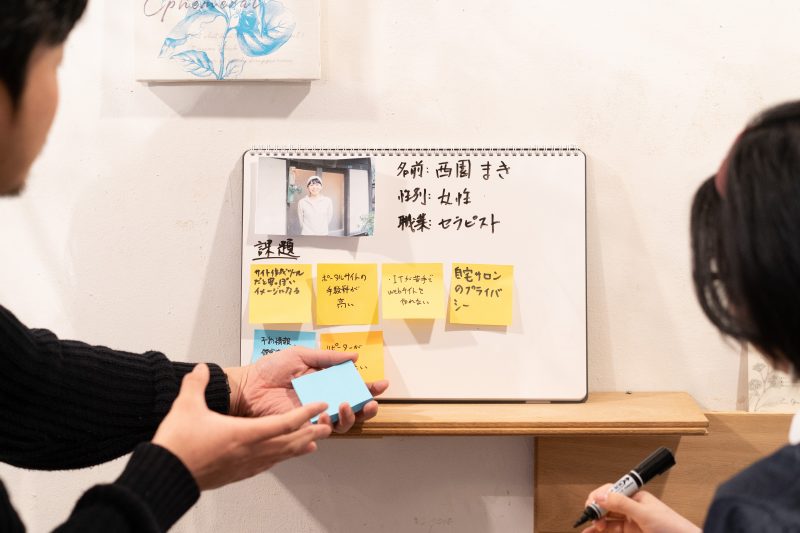
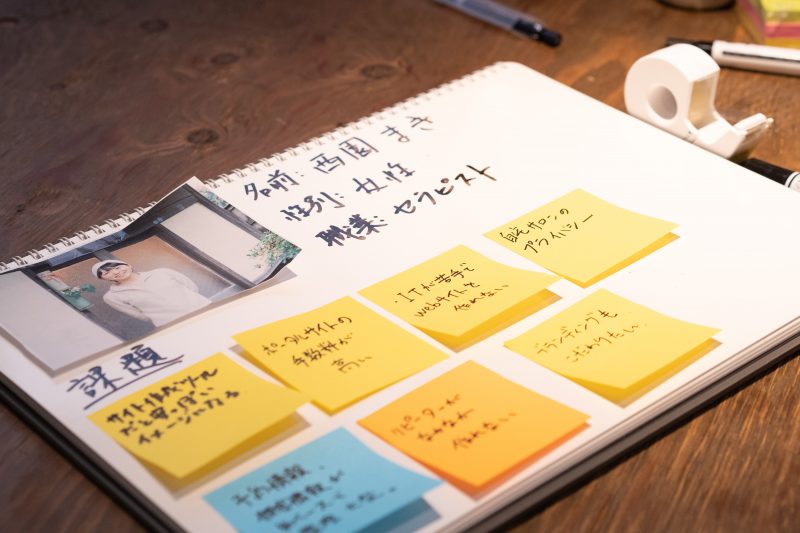
concrete sample of persona
This time, we set up the persona as follows.
- Name _
Nishizono-maki
- age
35
- Job _
therapist (owner of a private salon)
*I was an office worker, but I lost my health due to hard work and became a therapist.- gender _
woman
- Hobby|
Yoga
- Lifestyle _
Spend your time relaxing. Be mindful of one's health
- i'm from
Yokohama
- Place of residence|
Yokohama
- The media that we usually touch|
"Meido no Nihon" (Japan of Medicine) (a journal of oriental medicine and acupuncture massage)
- Personality and values|
Slow. I don't like competition.
- Job contents|
Management and Treatment of Swedish Massage Salon
- What do you feel are the challenges?
I’m not good at IT and the internet, so it can be a hurdle when creating websites.
You can’t use the existing website creation tools, and they look cheap.
Portal site-dependent attracters are less likely to make repeats and have a fee to pay.
Managing reservations and customer information is complicated with analogue.- What do you want to achieve?
physical and mental health of the visitors
Branding of your own salon, healthy management
success in attracting customers
efficient management of reservation information
It has become much more concrete than the customer segments set up in Lean Canvas, and there is a reality that says "I'm sure this person will be here" :)
Why should I set up a persona?
The advantages of creating a detailed figure so far are the following three points.
can share the target figure within a team
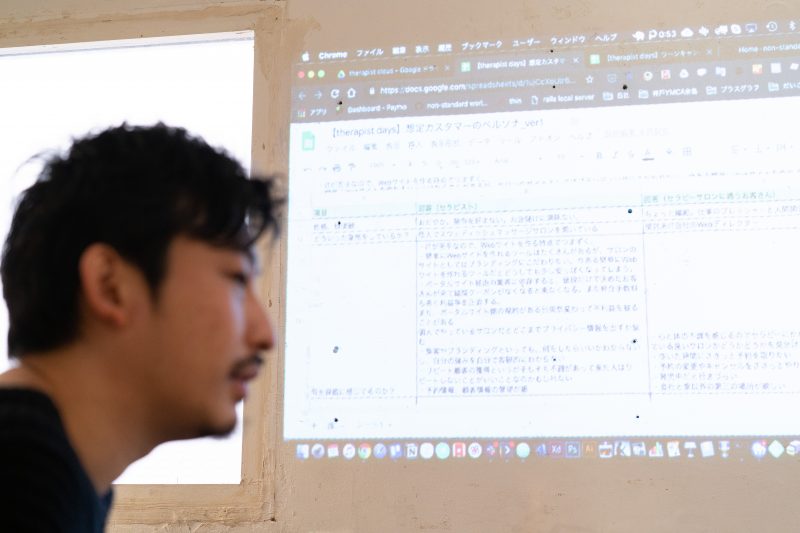
With simple information like customer segments, each team member’s imagination will be completely different; for example, personality, habits, web literacy, what pain you feel and want to solve — if everyone assumes a disparate user picture, it becomes harder to put together the direction or functionality of your project.
Setting up the persona and languageizing it creates a common belief that “users who use this service are like this”.
make it clear who to build
And when you set up a specific persona, people who should deliver the service become clearer.
Even if the project is about to stray, “I want that feature in,” you can cut down on waste and narrow down what users need from a perspective of “Is this really necessary for Persona?” If they’re designing personas.
help someone maintain a user perspective
Quantitative analysis is of course important when designing and improving services.
But relying only on numbers to determine the criteria makes it hard to imagine a user using an actual service.
Thinking about the behavior and emotions of a single user (which cannot be picked up by quantitative analysis alone) can lead to pleasant improvement or development for users.
empathy map
You can design a specific image of the user, but this alone seems like a character without a story and it may be a little difficult to become familiar with.
The next “empathy map” is a way to make it easier for team members to empathize with personas by visualizing their feelings.
concrete example of empathy map
Below is a empathy map that we have actually created.
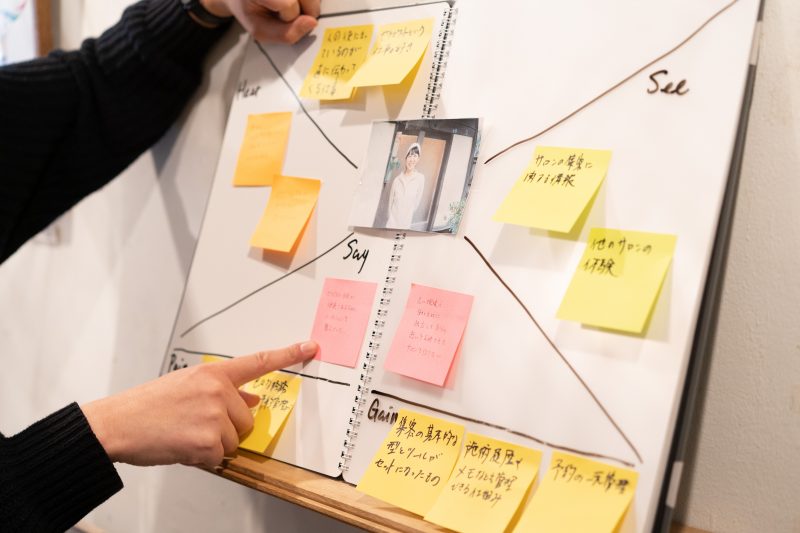
Persona’s thoughts and feelings on what they see and hear are divided into six groups.
what to put together a empathy map
In the empathy map, we consider the feelings of persona based on the following six categories.
- think (what you think, feel and want)
- hear (what you're hearing from your surroundings and the media)
- see (what are you looking at through your living environment or friendship)
- say (what you're talking about and how you behave)
- pain (as of fear or dissatisfaction)
- gain (not what you want to get)
These languageizations can be a hook for team members to empathize with their personas, helping them imagine “what would it feel like if they were personas?”.
customer journey
So far, we've been digging deeply into the persona and empathy maps of our users, but these are just assumptions from their creators: it is hard to objectively grasp everything even if people think that they can be developed, overlooked or biased.
So, another approach is to use a customer journey.
The customer journey focuses on the user’s action steps and describes how they act in their mind as they achieve a particular purpose.
concrete sample of a customer journey
While pasting imitation paper on the wall, we created a customer journey with all of our teams.
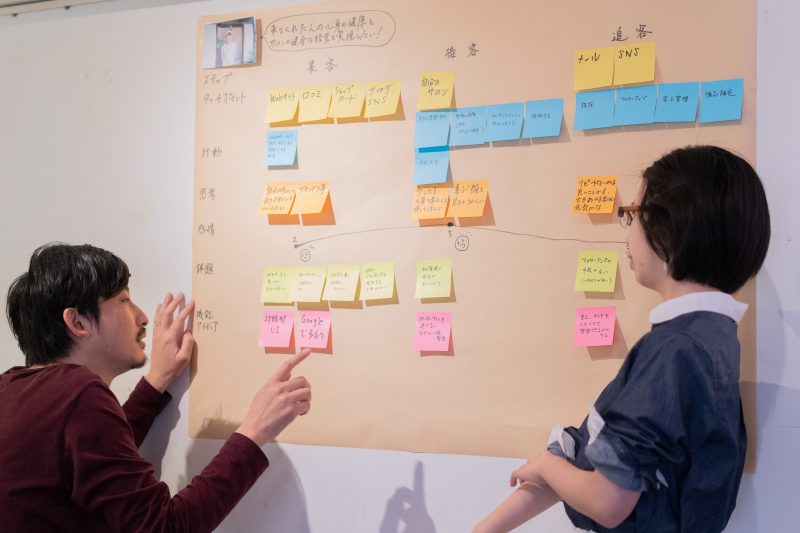
In this way, we will analyze the expected behaviors, emotions and thoughts for each user's action steps (in the sample, we divide them into three steps: customer acquisition, customer service, and customer pursuit).
How to make a customer journey
We are creating a customer journey in the following steps:
- confirm someone's persona We will check the figure of Persona who has dug deeply through lean canvas, empathy map etc.
- Determining Persona Goals (Customer Journey Goals) Set the goal that Persona wants to achieve (in the example, described in a blowout as persona’s words).
- write out a rough step Split the activities that Persona does to achieve these goals into rough steps.
- fall into detailed behavior Describe in detail what actions to take for each of the above steps.
- think about the thoughts that come with someone's behavior I imagine and verbalize what the reason for this behavior is.
- identify a contact (touch point) Through our actions, we think about how personas interact with each other and in recent years social media and smartphone apps have become very important.
- graph the emotions associated with someone's behavior You can see how stressed or dissatisfied you feel, and how strong your emotions are — at a rough level, drawn in line graphs.
- Persona's Challenge, Thinking about Solutions That's how we fill in all of our customer journeys. We looked at the whole thing again and thought about the challenges that users are facing with concrete behavior or emotions. We also wrote down some feature ideas that might be a solution to this.
Drawing concrete actions on a person’s image designed on paper makes it easier to notice the overlook and assumption of the creator, which leads to deepening discussions within the team about possible behavior for users.
Of course, the customer journey is not all-around and can’t be a tool to imagine everything you do.
However, the user’s feelings (especially “pain” emotions like frustration or irritation) associated with each action will be much easier to pick up.
at the end of
Each persona empathy map customer journey is a way to delve deeper into the expected users.
Like the lean canvas, instead of having it built once and done, we brush up many times as we proceed with the project to clarify "Whose is this a project for me?"
Well, I have refined the hypothesis of the problem so far, but in fact we have not yet confirmed the prerequisites for the issue.
It’s hard not to verify if there are really any assumptions that make a particular challenge happen, but instead start the project on your own, and then back again.
So, next time we will introduce a method called “Javelin Board” and the KJ Method that verifys prerequisite conditions through interviews.
Reference: Masayuki Tadokoro, Entrepreneurship Science Startup Science, Nikkei BP
Photo cooperation: Maki Yamabe (Swedish massage salon "La Présence" Therapist)