
Raw Project Sketch "Lean Canvas": A Non-sta Web App Development Flow That Lets You Try and Error

Hi. I'm Kawashima, an engineer! (Laughter)
In the short term, winter has come to an end and it's getting warmer. As long as I am happy because I can take a walk without worrying about lunch break.
Now, we at Nonsta are focusing not only on the website but also on the production of web applications.
It’s a web app that has a close relationship with our lives, but it may be more difficult to imagine how production will proceed after an order is placed despite its familiarity than the website.
The difference between a website and the web app
Web applications (web systems) realize various purposes by the user's operation to a website where the main purpose is to provide information.
It can be used in the browser, so you don’t have to install it separately; there are a variety of web apps around us such as online banking and online shops.
Among them, NONSTA specializes in creating web applications that streamline operations.
As a new feature, I would like to introduce the flow of web app development at Nonsta one by one.
If you are thinking about requesting a non-sta, or have already asked for it, I would be very happy if you could refer to the production step with this in mind:)
Contents [ hidden display ]
- Our Development Methods: Partner Collaborative Lean & Agile Development
- What is a Lean Canvas?
- Examples of creating a lean canvas: therapist days
- 1. Challenge: What are you in trouble with?
- 2. Customer segment: who will use it?
- 3. Proposing Your Own Value: Thinking about the Values That We Can Propose
- 4. Solutions: Specific solutions
- 5. Channel: How to Connect with Customers
- 6. Revenue flow: what makes you profitable
- 7. Cost Structure: What is the cost required to continue?
- 8. Key Indicators: What Do You Deem Successful?
- Superior advantage: Is there a strength that competitors cannot easily imitate?
- The First Hypothesis (Plan A) Completed! And Toward Continuous Version Upgrade
- instead
Our Development Methods: Partner Collaborative Lean & Agile Development
I will change the introduction to the first feature and tell you “why do we do that” before going into the introduction of specific methods.
Now that people's tastes have diversified, it is becoming increasingly difficult to predict what users want.
Based on a detailed plan, after a long development period and releasing the perfect web app according to specifications, it didn’t meet user demand (but I can no longer turn around because of spending my budget!)
and so we said, well Instead of creating a perfect product from scratch, we continue to develop small features and get closer to what users want. We have adopted the method.
By repeating development and improvement based on user feedback, the risk of creating functions that do not meet demand is low, and you can quickly create web apps while reducing costs.
We cannot complete the development alone because it is not a method to "make finished products once" but rather "to continue to improve while obtaining feedback".
As a client’s partner, we will think together and polish so that we can have good things together from verification of hypotheses and issues which are the beginning of the project to analysis and improvement after release.
That is how we develop.

The way we proceed with our project is by combining the management approach of "Lean" and the development method of "Agile".
If you would like to learn more about lean and agile, check out the article below.
- An Overview of Agile Development and Waterfall Development : Fujitsu Software Technologies: http://www.fujitsu.com/jp/group/fst/about/resources/featurestories/about-agile-01.html
- Combination to Understand "Design Thinking, Lean and Agile" by Jonny Schneider: https://link.medium.com/hJBB9wJXGU
We also explain the details on Nonsta’s website, so please check it out.
The Flow of Web Application Development|Web Production Company in Tokyo|non-standard world Co., Ltd
https://www.non-standardworld.co.jp/service/webappflow/
Now, let me introduce the specific methods that we are doing to achieve this by using an example of a non-sta web app currently under development.
The first feature in this article is a rough sketch of the entire project, “Lean Canvas.
What is a Lean Canvas?
The Lean Canvas is a method of hypothesizing the whole project at its planning stage without wasting time.
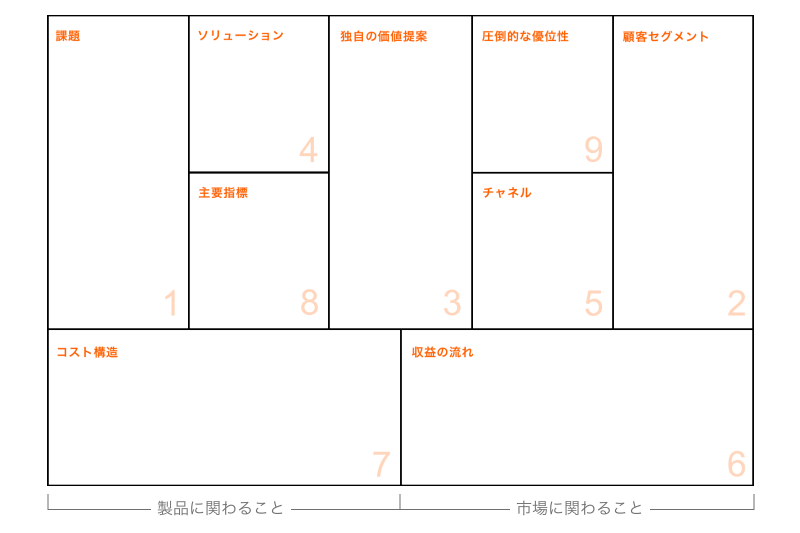
The nine key elements of the project are put together in a single diagram, and by filling out each element you can simply and quickly refine your hypothesis.
column: the history of lean canvas
Lean means "no waste, no tightening", and the Lean Canvas is a technique originally proposed in Ash Maulya's book Running Lean.
For more information on the concrete historical background and Lean Canvas, see the article below.
- How to Design a Business Model from a Successful Startup: The Lean Canvas https://ferret-plus.com/3174
- What is a Lean Canvas? Explains the difference between basic knowledge and business model canvas: https://limo.media/articles/-/6695
Benefits of Using Lean Canvas
Lean Canvas is not the end of building it once; unlike a business plan that has dozens of pages, it’s easy to create one so you can brush it up over and over again and increase the accuracy of your hypothesis.
It also covers the big picture of a project in one view, making it easy to share with team members. Who is this project for, and how do we solve it? It’s a huge benefit for the project to see it at first sight and act as a common perception of the team.
The nine elements that make up the lean canvas
It is the following nine elements that make up a lean canvas:It is recommended to fill it in number order.
More information on each item will be provided later with an example of a real lean canvas.
- task
- customer segment
- unique value proposition
- solution
- channel
- flow of revenue
- cost structure
- key indicator
- overwhelming advantage
Lean Canvasing Points
There are some things that I want to keep in mind when creating lean canvases.
The first two important factors are: task and said, customer segment When you fill these in first, the direction of the remaining elements is also determined and it becomes easy to think about.
And remember that in the early stages of an idea you may have some unfilled elements.
Lean canvases can be written over and over while validating hypotheses. If you modify the hypothesis for issues or customer segments, it will also affect other factors so that you don’t have to decide everything in detail from the beginning; just fill them up as concisely and quickly as possible.
Examples of creating a lean canvas: therapist days
So let's take the real lean canvas as an example and give us a sample entry for each item.
The project that will be dropped into Lean Canvas is led by Mr. Takasaki "We support the therapist's clerical issues with IT." The project is called “therapist days,” and we’re a big fan of Sexy Zone, with Inosent Days on our desk.

When creating it, he said: i've lived a lot of life. Thank you very much for your cooperation with our owner, Mr. Fukuda and Swedish massage therapist Maki Yamabe!
1. Challenge: What are you in trouble with?
Let’s start by hypothesizing the problems that our customers (who might pay for a service) want to solve.
Some ideas do not work unless there are customers on either side of the supply or demand (e.g., an auction app; if it is worthless to both buyers and sellers, then eventually they fail).
If applicable, consider a hypothesis from both sides of the lean canvas phase.
Here, we listed three of the possible challenges.
- Gathering customers via portal sites is hard to make repeaters, and it can be difficult to manage reservations. Intermediary fees will oppress profit margins.
- I want to attract customers on the salon website, but it is difficult to make one by yourself.
- Existing website creation tools are all designed and not branded.
2. Customer segment: who will use it?
Next, consider what kind of person can be a customer.
The more detail, the easier it is to come up with concrete hypotheses, so consider not only attributes but also actions.
Since the office burden seems to be heavier than a small salon, I will write it out as follows.
- someone who has a small salon (including one at home) and is open as an individual therapist
3. Proposing Your Own Value: Thinking about the Values That We Can Propose
Once the challenges and customer segments are solidified, consider the value proposition.
This is where the challenges and changes in customer segments change over and over again, and you don’t have to write them perfectly from scratch.
NONSTA specializes in design based on logic and sensibilities, as well as in developing web applications that enable business efficiency. Based on these strengths, we will write about the value that can be achieved only by ourselves.
- Making Salon-Optimized Websites Easy
- Working with social networks and notes to build relationships with salon customers (including potential customers)
- Efficiency of manual office tasks (reservation management, customer information management and sales management automation)
Hypothesis, customer segments and unique value proposition.
Once three of them have been filled up, we will make a concrete hypothesis to actually realize it.
4. Solutions: Specific solutions
We will consider measures that can solve specific issues.
This is also an item that can be changed depending on the verification of the issue, so there is no need to fill in details at this stage.
- A Web App That Creates Designed Website For Salon, Can Centrally Manage Reservations, Medical Records and Inquiries
5. Channel: How to Connect with Customers
Any solution doesn’t make sense unless you have a customer who uses it.
We will consider how to connect with our customers.
- Web
- a real salon
6. Revenue flow: what makes you profitable
We will consider a revenue model to make it work as business.
- monthly flat fee
7. Cost Structure: What is the cost required to continue?
Identify how much it costs to operate as a business.
- labor cost
- server cost
- advertising cost
8. Key Indicators: What Do You Deem Successful?
Consider the quantitative indicators you need to measure until you get your business on track.
- Monthly Revenue (MMR)
- rate of cancellation
Superior advantage: Is there a strength that competitors cannot easily imitate?
When comparing it to competitors, we will consider what can secure the advantage.
- Beautiful and user-friendly design, UI
- support for a variety of devices
- rapid processing speed
The First Hypothesis (Plan A) Completed! And Toward Continuous Version Upgrade
With these nine elements, all the lean canvases have been filled!
That being said, this is the first hypothesis: if you are using lean canvas as mentioned above, here’s where it goes.
You can share it with your team as a common language for projects, you can incorporate the opinions of your members to brush up and review the challenges in the first place through interviews or interviews... You’ll be refining project ideas over and over again from Plan A to Plan B to Plan C.
instead
This article introduces the first step in Nonsta’s web app development flow, lean canvas.
But the rest is that if you brush up a lean canvas, it's not going to get you started right away. Lean canvas is just your hypothesis; you need to know more about users who actually use an app so they don't hang out alone.
Next time, I will explain the method of “Persona Customer Journey” that delves deeply into the expected users:)