Defining the right problem and finding a way to solve it: An introduction to our design sprints

“If I had an hour to save the world, I would spend 59 minutes defining the problem and one minute developing a solution.”
Albert Einstein
Our company wants to be your companion.
As part of this effort, Google Ventures advocated design thinking before launching large-scale projects such as new construction and renewal. Design sprint We’re doing workshops called “the right problem” and exploring ways to solve it.
The general design sprint process looks like this:
1. Project objectives and current understanding : Clarify your goals and understand what the challenges are for them.
idea: We will come up with various ideas about how we can solve these problems and consider the best solution.
3. Decision: Take into account limited time and budgets, narrow down the idea of execution and make concrete plans.
4. Prototype: Create a prototype that you can actually experience.
5. Test: Get users to experience the prototype and gather feedback.
The original design sprint is a five-day series where all members including decision makers gather in real places, but it’s often difficult for the real work to do so, and we are working on our project in the style of taking time from 3 to 5 processes by doing 1 and 2 processes every 4 hours.
Here, we will explain the concrete way and how to proceed.

Contents [ hidden display ]
participating member
The decision makers are sure to attend the project, and we have adjusted it so that more than 7 members of the E-Commerce community can attend.
The purpose of the design sprint (workshop)
To grasp objectives, challenges and solutions in implementing a project
advance preparation
- Preparing for the biggest challenge in the project, problems that will have a greater impact if they are solved
- get someone to make a decision
note
- hold workshops for as many days as possible
- As a general rule, we do not use PC/smartphone so that we can interact with it in the deepest way possible.
- keep time in control
what we are preparing for on the day
- time table
- Imitation paper, magic, sticky notes and seals
- drink
- candy
- time-management alarm
Rule
- You can speak equally regardless of your position or experience, but it is the leader who decides.
- Talking is acceptable.
- Hope, suggestions and welcome at any time.
- Today's story is only here.
workshop content
day one
Self-introduction 20 minutes (about 3 minutes per person)
- name.
- where you live
- you're in charge of this project.
- what one likes or is interested in)
- this is the only secret. it's meant to be an icebreak.
Confirmation of Long-Term Goal: 30 Minutes
What do you want to be in six months or a year?
Confirmation and Linguisticization of What You Want to Realize Through Projects
Confirmation of challenges in achieving goals: 30 minutes
What would be the reason if this project failed in a year?
Identifying what is currently an issue and what may become a challenge in achieving long-term goals
Create a customer journey map to understand the target picture and its behavior: 30 minutes
- Diagram of the flow in which users and other parties use products/services.
Targets are what attributes the target user sees and purchases with an e-commerce site, identifies the flow to repeat as structure, visualized in a format called customer journey map.
Break: 10 minutes
Expert: 30 minutes.
interview an expert on the project if possible
do research and sharing on issues with members if it's difficult
How to Create, Classify and Vote Notes: 30 Minutes
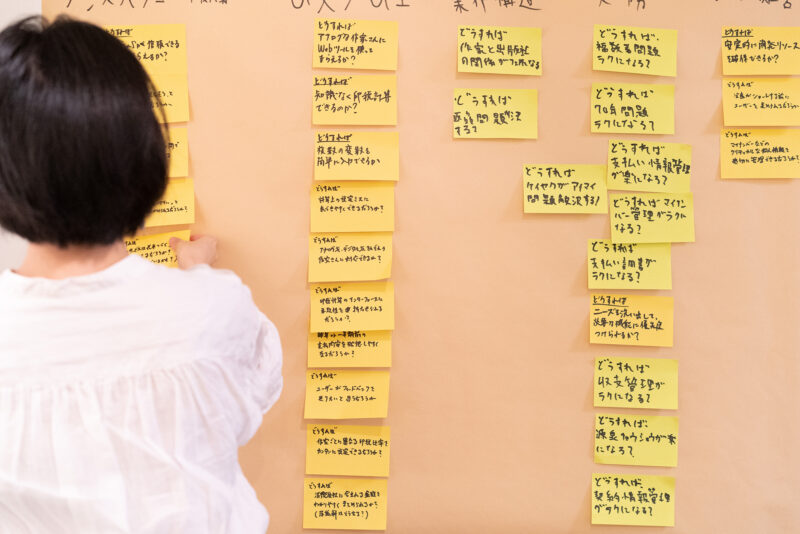
So I created a sticky note about the problems that came to mind in the format of "How can you do it?"
In a vote to select important issues from among them, the decision makers vote 4 votes and other members vote 2 votes.
Targeting: 30 minutes
To determine who is the most important user and what moments are most important to that user.
day two
GOOD & NEW 15 minutes
For the purpose of an ice break, each member may have found a new discovery within two weeks; someone who speaks will nominate another person.
Previous case study 40 minutes
Based on tasks organized in the Customer Journey Map, we will bring up a reference case (or our own case) and share what each of them thought was good.
Only this workpiece can be used for PCs and smartphones
break, 10 minutes.
note, 20 minutes.
In 20 minutes, you’ll get a copy of your long-term goals and notes for yourself that might be useful from previous ideas.
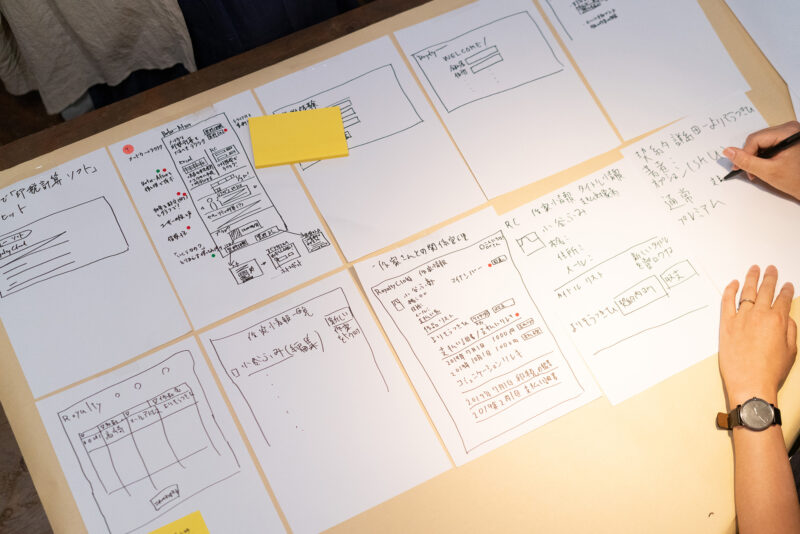
rough sketches of ideas, 45 minutes.
Each member thinks of an idea to solve a problem (anonymously)
an exchange of ideas for 30 minutes.
- explain the idea and vote where one thinks it is good
- Apply a sketch to stick the sticker on your favorite area (unlimited)
- pick up areas where the facilitator has a lot of stickers
- tell the person who made ~ to stand out and add it
- Looking back on the long-term goals, sticking seals to areas that members think are best and explaining why.
- Three decision makers stick their ideas to them
Overall Design Sprint Retrospective: 30 minutes
We share our retrospectives in the order of things that are good to try, tripping and what we want to do next.
Finally,
Most of the people in our design sprint are not experienced, but if you hold a workshop
"I was able to talk objectively with third-party facilitators because I couldn't speak easily in my busy day-to-day work."
"I'm hungry because I can make it clear what my goal is."
"I'm glad I could sharewhat I was thinking about the challenge."
You can feel the effect.
I think that our work is like a primary doctor for customers, but if we define the problems to be solved properly and share the opportunities to solve them, it’s up to our clients themselves to heal and grow.I am always impressed by how their team members who were nervous at first actively discuss and even think about solutions.
Our staff are looking forward to seeing you in a design sprint, even if you’re reading this article someday.
reference
『 SPRINT: The Fastest Workmanship, the Most Reasonable Way Every Work Works Jake Knapp, John Zerazki, Braden Cowitz, Diamond Company
『 Design Sprints: A Short-Term, Centralized Practice Guide to Product Success Richard Banfield, C. Todd Lombardo by Trace Wax and O'Reilly Japan