Whitespace in traditional Japanese culture

Contents [ hidden display ]
video version
Hello, I am art director Sato.
Today, I would like to introduce a few examples of values that value the margins of traditional Japanese culture influenced by my view on design.
margin of painting art
Tosa Mitsuoki's Word
During the Edo period, Tosa-ha painter Mitsuoki Tosa wrote a book about paintings called "Honcho Gaho Daiden" (The Great Den of Honcho-gaho) as follows:
If a blank sheet of paper is in the pattern, it will be filled with heart.
Unlike the way of painting until the impressionist era in Western art, which does not leave a negative space by drawing even details in search of reality, there has been a variety of margins for "filling with mind" in Japanese art.
Tohaku HASEGAWA's Shorin-zu folding screen
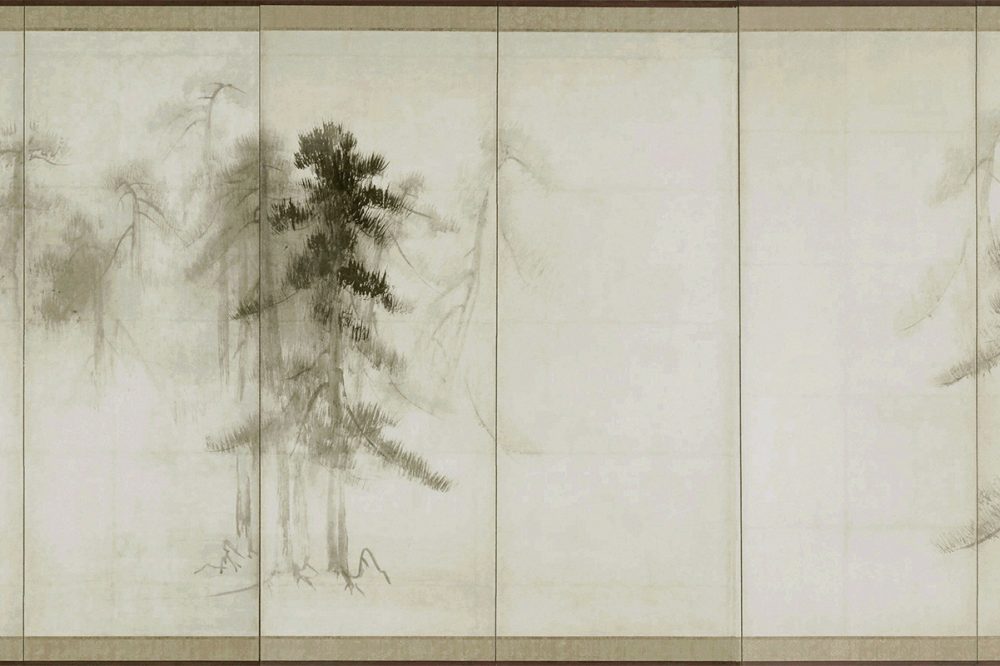
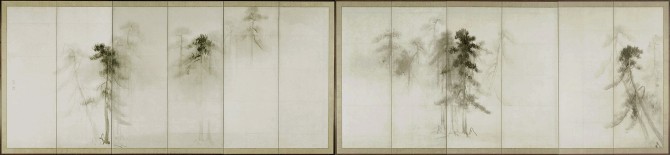
A national treasure ink painting by Tohaku Hasegawa of the Azuchi-Momoyama period, "Shorin-zu Byobu" leaves many margins between trees; white space is an atmosphere, fog, and a myriad of pine trees covered in it.
Tohaku HASEGAWA's Shorin-zu folding screen
It is because this margin evokes the imagination of those who see it, that I think this work has the power to subconsciously pull into its world as if inhaled by fog.
Korin OGATA: 'Kohakubai-zu Byobu
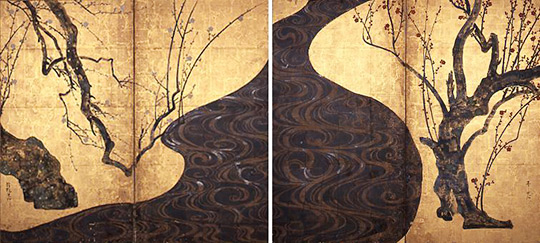
There are many works that actively incorporated margins into the works of the Yodo school in the Edo period, one of which is a national treasure by Korin OGATA and red-white plum painting folding screen.
Korin OGATA: 'Kohakubai-zu Byobu
The background is not drawn at all, and by making it a margin of gold, I feel the infinite depth and spread there.
space of spatial art
dry landscape
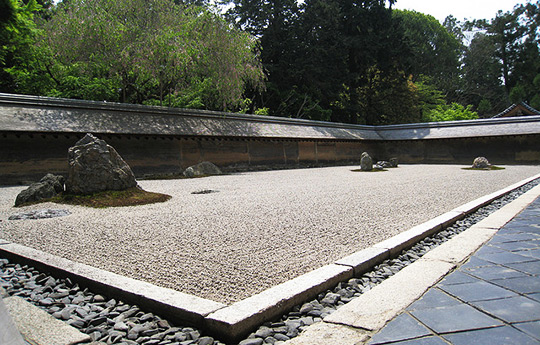
Karesansui, a garden without water; the dry landscape developed in Zen temples has an imaginary margin that makes you feel water by subtracting it. It forms a world view based on "appearance" reminiscent of white sand and pebbles.
The stone garden of Ryoan-ji Temple, a world heritage site, is such a dry landscape garden.
The stone garden of Ryoan-ji Temple (Kyoto)
margin of comprehensive art
tea ceremony
In the Azuchi-Momoyama period, there is a lot of space in the tea ceremony that SEN no Rikyu completed and pursued loneliness.
Rikyu’s tea ceremony was designed to remove waste, and the tea room used a very narrow area of 2-3 tatami mats with simple tools.
A famous anecdote is that Rikyu, who invited Hideyoshi Toyotomi to pick all the flowers in his garden and put only one of them into her tea room because he had a beautiful morning face blooming on the garden.
OKAKURA Tenshin, who introduced the tea ceremony abroad, described these aesthetics.
complete this with imaginary action without intentionally making something)
That's what he said.
the margins of performing arts and literature
In the performing arts such as Nohgaku and literature such as haiku, there is a sense of beauty in the margins.
The time of silence in the Noh stage between a wolf and a wolf, which has an important meaning as a temporal margin.
Haiku pursues the spread of images hidden between lines from short words that have been cut off.
Originally, "Don't talk too much" was something I naturally thought about in my craftsmanship, but as I learned the values of traditional Japanese culture that linked with it, I began to treat space more consciously.
Next time, we will introduce what you are aware of when you actually do the design that leaves a margin.
Reference:
Tenshin OKAKURA "Cha no Hon" (The Book of Tea) (Kodansha)
"Haku" by Kengo HARA (Chuo Koron Shinsha)
Shogo MATSUOKA "Sansui shiso" (The Thought of Sansui)
Shutaro Mukai, "Katatsu no Shigaku" (The Study of Poetry) (Art Publishing Company)