
Building an analytics framework for healthy ecommerce growth: CPO, LTV and ROAS

Contents [ hidden display ]
Introduction: Business Structure of EC Sites
In order to make a sale on an EC site, you need to pay for attracting customers.
It is an image that 10,000 people look at the advertisement and 7 people buy it using web advertising etc.
And even if you have trouble doing so and get one customer to shop, it is not possible to recover the cost of attracting customers just by having them buy once.
Therefore, it is important not only to have you buy once but also build a long-term relationship with your customers and make them purchase many times so that the business can be established.
In the expression,
お客様にオンラインショップでお買い物してもらうまでにかかった費用 < 一年間でお客様に買い物してもらった粗利の合計It is said that it will be possible to grow inevitably if more than three times.
What numbers should we look at to build a healthy and growing EC site?
For this reason, it is important to prepare an analysis system and grasp the numbers.
Here are some of the metrics you should see in particular:
The cost of getting customers to shop online: CPO
CPO (Cost Per Order) is the cost of getting customers to shop online.
マーケティング費用 ÷ 注文数For example, if there are 100 orders at a marketing cost of 1 million yen, the CPO is 10,000 yen.
CPO standards vary depending on the product, for example, CPOs on direct sales e-commerce sites of apparel usually fit into the following range.
- For new customers: \3,000 to \8,000
- For repeat customers: \500 to \2,000
By marketing channel, there are the following trends.
- Google Listings: A relatively high CPO (¥4,000 to $10,000)
- Social Network Ads: A Medium Scale Depending on Targeting Accuracy
- Retargeting: Lower Ads (¥1,000 to \3,000)
- Email Marketing: Very Low
It is also related to the unit price of products, and as a general guide, 15%-25% of the average unit price of goods are in the appropriate range of CPOs.
- Example: If the average unit price is 10,000 yen, CPOs are ideally between 1,500 and 2,500 yen.
Calculation of CPOs at the upper limit on ad spend
And in addition to the above, our company has said Minimize sales, maximize profits We also calculate the upper limit and upper limit CPOs of advertising costs that can be charged to this point.
The more the promotional cost is spent, the more sales will grow, but at some point it hits a point where the cost-effectiveness of “the higher the promotional cost does not increase,” which we call the upper limit CPO and calculate by comparison with LTV described below.
The Total Roughness of Customers' Revenue Over a Year: LTV
LTV (Lifetime Value) is the total amount of gross profit that one customer has purchased in a year.
It is common to calculate by sales, but in order to understand the more accurate management situation at our company we recommend that you do so if you can calculate on a gross profit basis.
LTV Calculation Method
LTV = 粗利ベースの平均注文金額 × 1年間の平均購入回数Why is it important to watch LTV?
-
Evaluation of Customer Acquisition Cost (CPO)
- Even if you spend 5,000 yen to acquire a customer, if the customer's LTV is 15,000 yen, investment can be recovered.
- Generally, “LTV:CPO = 3:1” or more is considered ideal.
-
optimal allocation of marketing budgets
- to determine which ad channelsand customer segments should be invested in.
- you can identify the high levels of ltv customers, and focus your budget on them.
-
Development of Repeat Purchasing Strategy
- You can analyze customer behavior after the first purchase and consider measures to improve repeat rates.
-
optimization of product development and assortment
- High LTV customers can strengthen their product lineup based on their purchase trends.
-
measurement of the effectiveness of customer-maintaining measures
- you can determine the effects of email marketing, loyalty programs, after-sales services
General E-Commerce Measures for Improvement of LTV
- personalized recommendation
- Repeat Purchase Discounts and Point Program
- offer a subscription option
- enhancement of after-sales service
- optimization of mail marketing
- Improving the customer experience (e.g. ease of use, delivery and return policy)
Time Series LTV, Calculation of LTV by Commodity
And when it comes to LTV, the North's master Minimize sales, maximize profits The following numbers are calculated on the basis of ".
Time Series LTV
- Since the customer’s purchasing behavior changes over time, we understand the change in repeat rate and purchase price after a certain period of time from the first purchase, and help us to consider what kind of customers should approach.
product LTV
- By calculating LTV for each product, you can clearly understand which products will produce high returns in the long term.
ROAS Seeing the Cost Efficiency of Advertising
ROAS is an abbreviation for Return On Ad Spend, an important indicator that measures the efficiency of marketing and advertising campaigns.
ROAS is calculated by the following formula: ROAS = Revenue from advertising Advertising cost
For example, if a 100,000 yen advertisement cost earns 500,000 yen in sales, the ROAS will be 5 (or 500%).
The main reasons for seeing ROAS:
- Measure the effectiveness of your advertising investment: you can see which ad channels and campaigns are most effective
- Budget allocation optimization: you can focus your budget on ads that show high ROAS.
- Campaign Improvement: Understand which elements are successful and adjust your strategy.
- Confirming Investment Efficiency: An Overall Marketing Strategy Can Be A Measure Of Profit
In general, if your ROAS is at least 1 (or 100%), it means that you can recover at least advertising costs.
The ideal ROAS value varies depending on the industry and goals, but in many cases more than 4 are considered to be good.
How to see the numbers above on Shopify
1. Improvement of UTM Parameters
UTM parameters are a mechanism for tagging URLs that allow you to track and analyze traffic to websites.
This allows you to measure CPO, LTV and ROAS correctly.
There are five general UTM parameters:
- utm_source: source of traffic (Facebook, Twitter, newsletters etc.)
- utm_medium: marketing media (paid advertising, social networking, email, etc.)
- utm_campaign: specific campaign name
- utm_term: a paid search keyword
- utm_content: Parameters to distinguish different ads and links within the same campaign
For example, there is a URL like this: https://example.com/?utm_source=twitter&utm_medium=social&utm_campaign=spring_sale
From this URL, you can see that visitors come from a Twitter (utm_source) social media post (utm_medium), and are part of the "spring_sale" campaign (utm_campaign).
Analytical tools like Google Analytics allow you to organize and analyze traffic data based on these parameters.
You can measure the effectiveness of which social networks and ads are effective.
We make and manage these tables.
Shopify has the ability to record UTM parameters when there is a conversion (purchase or registration, etc.
Shopify’s analytics feature automatically tracks UTM parameters (such as utm_source, utm_medium, utm_campaign, utm_term, and utm_content) when a visitor reaches the site and stores them in association with subsequent conversions.
This allows for the following:
- see which marketing campaigns are most effective
- you can analyze which ad channels your visitors are most likely to buy
- Calculate the ROI of Marketing Investment
You can see these UTM data in the Analytics or Reports section of your Shopify Admin screen, and you can also do more detailed analytics by integrating Shopify with external tracking tools such as Google Analytics and Facebook Pixel.
2. Installing tools to analyze LTV/CAC
We analyze Shopify’s CAC/LTV with our own tools.
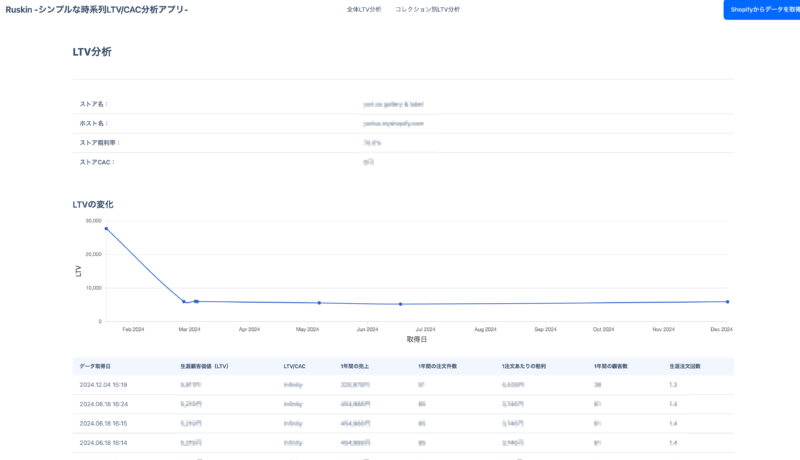
We use our own app to check LTV for improvements.
The reason we developed it is because we wanted to do more accurate analysis by checking LTV on a gross profit basis rather than sales base.
For other companies' tools, we recommend the Shopify app called ECPower which has a UI that is easy to understand and runs fast.
Finally: Your feelings always appear in the numbers
In order to establish an EC business, it is not necessary just to make efforts, but to take measures by capturing the feelings of customers who appear somewhere in the numbers.
By carefully analyzing the above-mentioned indicators and listening to your voice, you will be able to operate a better EC site.
In the non-standard world, it is possible to support everything from web marketing to web production and building Web applications.
If you're interested, here Please contact us by all means.