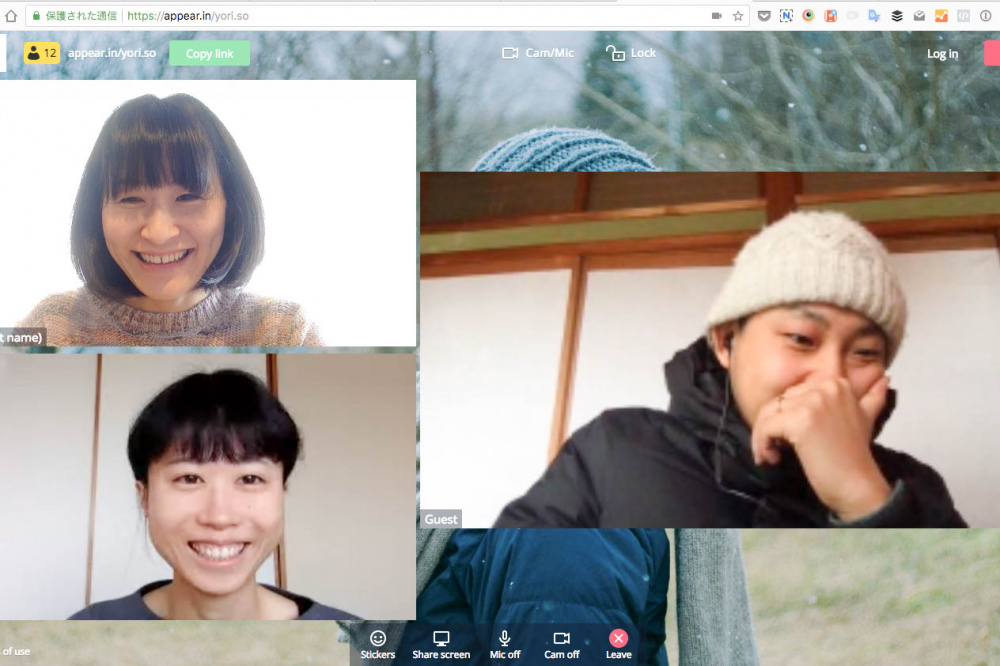
An introduction to Scrum: Balancing team members' autonomy with organizational goals

Hi. I'm Representative Takasaki.
At our company, we have been working with the team for six months by adopting a system called “Scrum”, which is a team art to make intelligent products.
Scrum was originally born for software development, but it works well for everyone who is struggling with "working on a team" I think so.
I myself have worked in various positions from the side of hiring people, the person who hires people, the person who orders projects and the person who receives orders.I feel that this "Scrum" framework is an optimal solution to move towards one goal as an organization while respecting the autonomy of its members, even though adults with different interests they bear or believe are right.
In this article, I would like to provide an explanation about Scrum and a introduction manual for those who want to introduce it.
Also, the technical terminology is replaced with plain words as much as possible, if you want to learn more please check out our last reference!
Contents [ hidden display ]
What is Scrum?
It was originally born in the United States as a way to develop software for teams.
The following are the characteristics.
- Instead of having to go through a large PDCA cycle once, instead of having the premise that you can’t set up a complete plan that foresees all possible impediments in your project, you are flexibly responding to changes with lots of small PDCAs and learning with teams to get the project done.
- To create a team by empathy, resonance and resonance while cherishing not only logic but also the “emotions and autonomy” of members on the assumption that humans do not turn in the same direction easily.
Personally, the essence of Scrum:
"It's not about "no management" or "strong control", but "soft management" that respects autonomy is important." -- Agile development and Scrum.
— Kenji Takasaki (@nplusone) April 25, 2018
The ideal for my company is to have a good team that “looks at and leaves it up.
I think it's there.
How We Introduce Scrum
Our company is a work style where employees are free to work from home, free time to work and members are all over the country.Last summer we had two new staff members working at our company, and while focusing on remote work, it was necessary for us to share the values and culture of the company with people who were completely new to the company.
So if you're interestedin this story or something else, here Read more about it.
In the world of WEB production where there is a lot of change, we met this method called Scrum when we were looking for ways to speed up production in teams while flexibly responding to changes while maintaining quality.
First of all, I would like to explain the tools and the flow.
Scrum Flow
1. Preparation of IT Tools
We use the following tools for Scrum:
- github
Project management tool.
- zenhub
This tool makes github’s task management table more manageable. Trello I think there are many companies that use task management tools such as .
- appear.in
Every morning meetings and MTGs use this web conferencing tool.
determine the role of 2.3
In Scrum, we decide on three roles first.
- Product Owner
someone who has a vision for the project and decides what to do)
- development team
actual member of the project
- scrum master
to make Scrum work. service-oriented leadership someone who helps a team succeed in
3. Sharing goals and thoughts of the project
At the beginning of a project, we will share how it can be useful to society and how members feel about getting involved in this project.
In the book I read, before P of PDCA cycle it was written that "S" would be made.
It's important to put S before the PDCA cycle. S is Socializion. Before planning, share your subjectivity and passion with people around you, creating "empathy, resonance, resonance." No innovation occurs without that process - book: Agile Development & Scrum (Agile Development) https://t.co/R0eLwT28Wt Abstract: A numb word!
— Kenji Takasaki (@nplusone) May 1, 2018
We share our project vision and strategy with the following methods:
elevator pitch
It is a method to explain the project so that it can be explained even in 30 seconds on an elevator, and I make it with the following sentence.
- What does our “project name” service do?
target request
aimed at
The service named [Service Name]
[Service Content]
This can be [the strength of service],
unlike any other service
have a differentiator in service
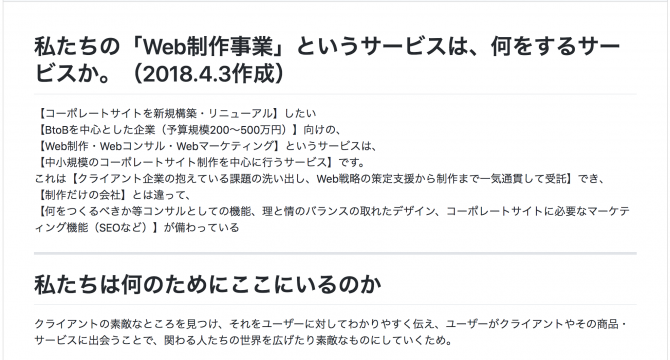
For example, our web production division shares the following elevator pitches with its members.
- What does our “web production business” offer?
I want to build a new corporate website
for companies centered on BtoB.
a service called web production
[Services that mainly produce small and medium-sized corporate sites]
This can be done [Identifying the challenges of client companies and entrusting them with everything from support for developing web strategies to production].
Unlike a production-only company,
[It has functions as a consultation such as what to create, design that balances reason and emotion, marketing function necessary for corporate site (SEO etc.)]
Why are we here?
After the elevator pitch is over, each member announces his or her personal motive: “Why am I involved in this project?” and finally makes a statement as to why our team is here.
In our company's web production business, it is as follows.
- what our team is here for.
To find out what’s great about our clients, to communicate them to users in an easy-to-understand manner and to expand the world of those involved by meeting with their clients, products or services.
This elevator pitch and the statement as a team, "Why are we here?", are placed in places where teams often see them so that they always remember their starting point.
4. Determine the sprint period
I’ve just mentioned that Scrum will turn a lot of small PDCA cycles, but the duration of this little PDCA cycle is called “sprint period” and we decide on sprint periods between 1 week and 4 weeks according to project size.
At our company we are doing Scrum in a two week sprint period.
5. Sprint Planning
This is the beginning of a PDCA cycle called real sprints.
First of all, we plan with the following flow.
5-1. Identify project tasks
Scrum shares tasks with the whole team in a "Kanban" way of managing issues that was originally created at Toyota.
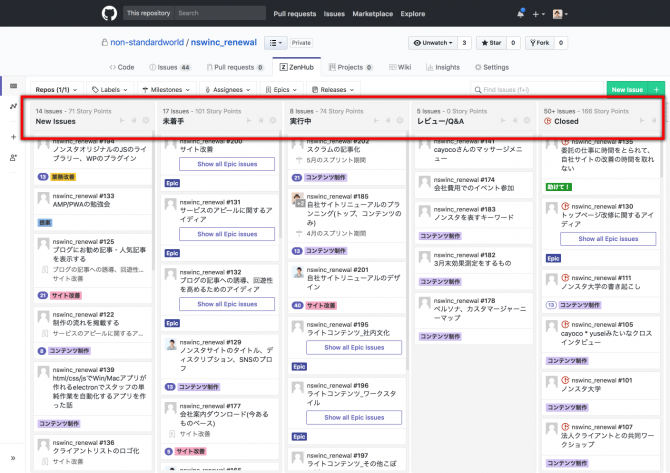
State of Task Management Using our github/zen hub
In this Kanban-style task management, the tasks are divided into:
- unfinished move
task that hasn't started yet
- running
Tasks to be executed during this sprint period
- Review QA
a task that is finished and waits for the Product Owner to confirm or ask questions etc.)
- Closed
completed task
5-2. Fill out user stories for each task
In order to share the purpose of each task, we use a format called User Stories that shares what it means when viewed from our customers.
as a user of the job
I want to do that task.
Because [why do that task].
For example, if you add a function that allows you to download the PDF of company information on our site, it will be in this form.
I want to download Nonsta’s company information as a person in charge of the corporate site.
This is because it’s easier to have a company guide to talk with your boss about where you are for web production companies.
5-3. Set the completion criteria for the task
Once you have shared your goals in the user story, we will now share criteria for what to complete that task.
In the above example, we set a completion criterion that our company guide is ready to be downloaded and tested in a test environment.
Preventing unfortunate crossovers between the workgirl and the receiver by clearly defining and sharing objectives and desired completion criteria. 。
5-4. Estimate the man-hours of the task together
Next, we estimate the man-hours of that task.
Estimates are estimated by the number Story Points, taking into account the time and difficulty required to realize a user story given to each task.
In addition, the estimate is characterized by all members on the premise that "humans are not good at accurate estimation but can guess roughly size by comparison", and everyone thinks how many tasks will be compared to the one before finishing the easiest task.
Further estimates are made using the following rules, called Planning Poker.
- all say the numbers at once (not influenced by someone's opinion)
- If there's quite a bit of variation in numbers, you can all talk about the reason and re-estimate it up to three times.
- adopt an average that exceeds the maximum and minimum if it does not match in three times)
5-5. Put a task to be executed during the sprint period into "running"
Up until the previous process, we have identified and shared with our members the purpose of doing tasks, the degree of maturity required, and the effort required to perform them.
Finally, the Product Owner decides what to do during this sprint period and puts it into "running" of the task board that is managed in the Kanban style mentioned above.
Members receive it and fill in the setup for task execution.
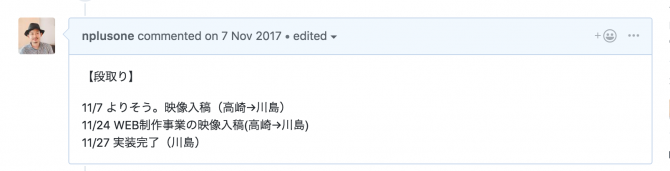
6. Morning meeting (Daily Scrum)
After the sprint begins, all team members meet in the morning with a goal of 15 minutes every morning and each member announces:
- what i did yesterday
- what someone is going to do today
- tripping in one's work
In addition to confirming the progress of every day in this way, we will discuss solving if each member has tripped.
If the discussion is too long, only those involved in that issue will remain and continue MTG as a second session.
The completed task will be moved to the completed item.
A graph of the completed task's story points is called a "burndown chart" and we check in this graph to see if tasks are successfully digested.
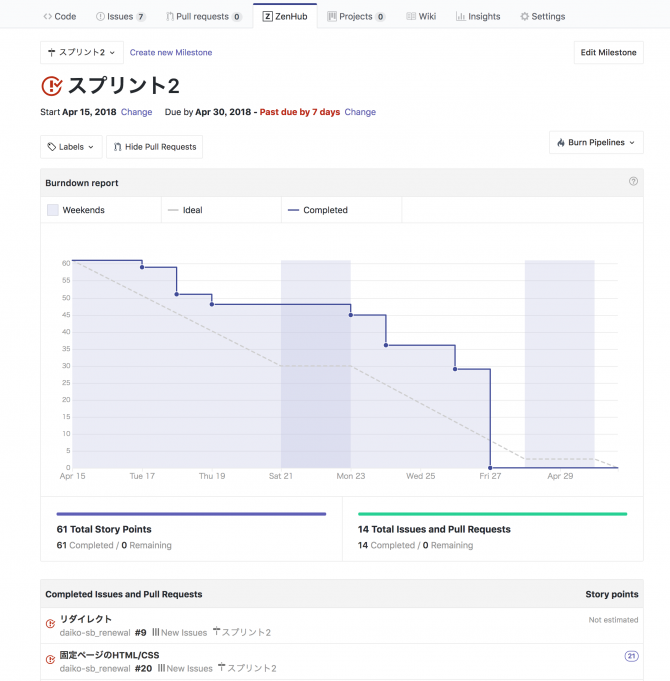
Burndown chart: The horizontal axis displays the time and the amount of work digested by the vertical axis.
7. Presentation of deliverables (Sprint review)
On the last day of the sprint period, we will show off all completed tasks.
8. Retrospectives
We use a framework called KPT (Kept) to reflect on this sprint period with all the members.
KPT stands for Keep, Problem and Try, and we will announce the following.
- Keep
This time, I would like to do something good and continue.
- Problem
What I tripped this time, and what I felt about the challenges
- Try
what one wants to try next
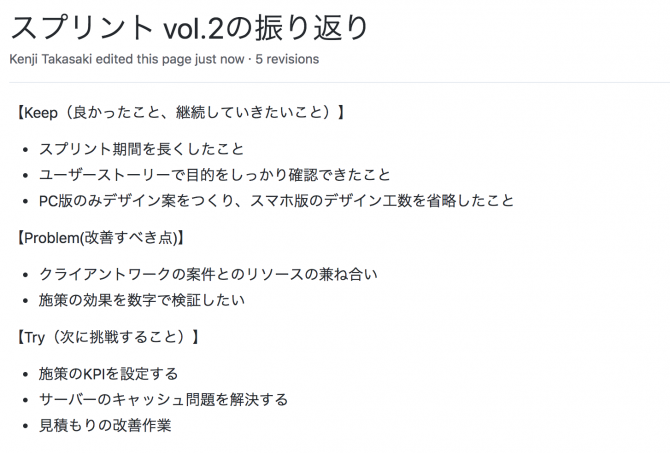
Retrospectives at our company
There is also meaning in this order, so let’s publish it in Keep, Problem and Try order.
This ends the sprint period.
If the project continues, we will go back to 3 and repeat this small PDCA cycle called "sprint" until 8.
If you want to learn more,
It's very easy to understand because it explains Scrum without using the word.
in the book here The book was written very well, so please check it out!The author of a famous book that studied the typical failure pattern of Japanese organizations called “the essence of failure” has also joined me, and there is a very good content as a company organization theory in the future beyond just development theory.
So, I'd like to end this article with the hope of working together in a good team.
Thank you for reading to the end!